A natural-looking hair transplant depends more on how the hairline is designed than on how many grafts are moved. The shape, position, angle and spread of density decide whether new hair frames your face or looks placed. A big graft number on its own says little about how the result will look.
Here is what good hairline design involves, why it should plan for the future, and how to judge a proposed design at your consultation.
Why is graft count not the full story?
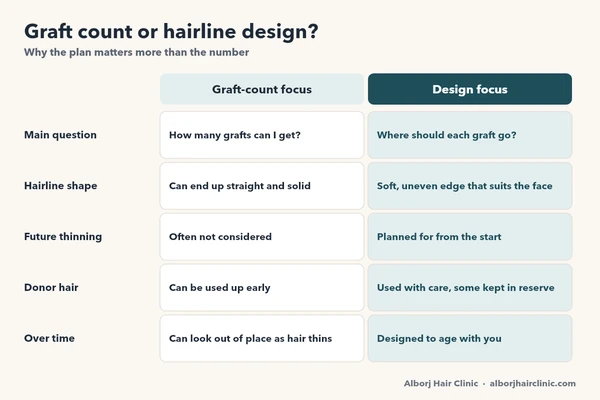
Graft count is easy to compare, so it tends to dominate conversations about hair transplants. But it only tells you how many follicular units will be moved, not where they will go or how they will sit.
Each graft is a small natural group of about two to four hairs. Two people could receive the same number and end up with very different results, depending on how those grafts are placed.
Donor hair is also limited. The back and sides of the head can only give so much. Every graft spent in the wrong place is one you cannot use later.
What makes a hairline look natural?
A natural hairline is never a ruler-straight line. Look closely at anyone with a full head of hair and you will see a soft, slightly uneven edge that grows denser behind it.
- Shape. The outline should follow your face, with gentle curves at the temples rather than a hard, flat front.
- Position. The height needs to suit your face and your age, not the look you had at 18.
- Angle and direction. Front hairs naturally grow forward at a low angle. If they stand straight up, the result can look unnatural from the side.
- Density distribution. The finest grafts sit at the very front, with fuller ones behind, so the edge looks soft rather than solid.
The DHI (Direct Hair Implantation) technique helps with this detail. The surgeon places each follicle individually with an implanter pen, setting its angle and direction one hair at a time.
Why should a hairline plan for future thinning?
The transplanted hair itself should last, because established follicles normally grow for life. The original hair around them, however, can still thin with age.
If a hairline is set low and dense to look full today, a gap can open up later between it and thinning hair behind. That can look odd, and correcting it uses more of the limited donor supply.
Grading scales help here: Norwood for men and Ludwig for women. A careful plan considers where thinning may go next, not just where it is now.
“The hairline I design has to suit the patient in twenty years, not only next summer. A slightly higher, softer line usually ages better than a low, heavy one. It also keeps donor hair in reserve in case the hair behind it thins.”
Why does a conservative hairline age well?
A conservative design is slightly higher and softer than the hairline many people first ask for. It can feel less dramatic at the start, but it tends to look right for much longer.
Hairlines naturally sit a little higher as people get older, even in those who never go bald. A mature hairline looks at home on a face of 45, while a teenage one often does not.
How does your hairline change the way you can style your hair?
A hairline frames the face in the same way a good haircut does. When the edge is soft and well placed, you are free to wear your hair off the face.
- Swept back. A natural edge holds up to being seen, so you do not need a fringe to cover it.
- Short crops. A soft front still looks believable when the hair around it is cut close.
- Side partings. Hairs set at the right angle fall the way you style them, rather than sticking up.
A hard, straight hairline tends to limit you, because many people then style their hair to hide the edge. Once the new hair has fully grown in, a good barber or hairdresser can shape your cut around the line.
How can you judge a hairline design at your consultation?
You do not need to be an expert to ask good questions. Look for a surgeon who talks about design at least as much as numbers.
- Ask to see the proposed hairline drawn on your scalp, and look at it from the front and the side.
- Ask how its height was chosen and how it will suit you as you get older.
- Ask how the front edge will be softened and how density will be spread behind it.
- Ask about the angle and direction the new hairs will grow in.
- Ask how much donor hair you have and how the plan keeps some for the future.
If the conversation stays on graft numbers alone, keep asking. A sound plan should explain why each area receives the grafts it does.
About Alborj Hair Clinic
Alborj Hair Clinic is a hair transplant clinic in Mazaya Centre, Al Wasl, Dubai. Its surgeon, Dr Dimitrios Ziakas, has 24 years of experience and has performed more than 4,000 hair transplant procedures. He is a member of the International Society of Hair Restoration Surgery (ISHRS) and uses the DHI (Direct Hair Implantation) technique.
If you would like your own hairline assessed, you can book a consultation with Dr Dimitrios Ziakas at Alborj Hair Clinic.
Before-and-after case studies from past patients can be viewed on the clinic’s website.
Frequently asked questions
Can my hairline be lowered as much as I want?
Not always. The surgeon has to weigh up your face, your age, how much donor hair you have and how your hair may thin in future.
Does a higher graft count mean a better result?
Not on its own. How the grafts are placed, angled and spread matters at least as much as how many are moved.
Can women have a hairline designed too?
Yes. What matters is patterned thinning and a good supply of donor hair. The design is then shaped around the person’s face and natural parting.
When will I see how my new hairline looks?
You will usually see early growth from around month three. Over the following months the line softens and fills in, and the full result shows at around 12 months.